Selling one-page websites to local businesses on WhatsApp: the demo-first system, end to end
The whole Local Client Sites loop in order: the qualifying filter, the ten-minute demo, the opener that is a live link, the two follow-ups, the six-item intake, the 24-hour handover, and why the monthly care fee is the real business.
A movers-and-packers firm with 223 reviews at 4.8 stars, a mobile number on the listing, and no website. That listing is the entire market for this system, and every city has hundreds of them. The owner does not want a website. The owner wants the phone to ring. A one-page site that puts the real reviews, the working hours and a green WhatsApp button in front of the next person searching is the closest thing to that.
I packaged this loop as Local Client Sites in a Box after watching the same cold pitch fail over and over: "Hi, do you need a website?" The fix is not a better pitch. It is a different order of events.
Why does the demo go out before the pitch?
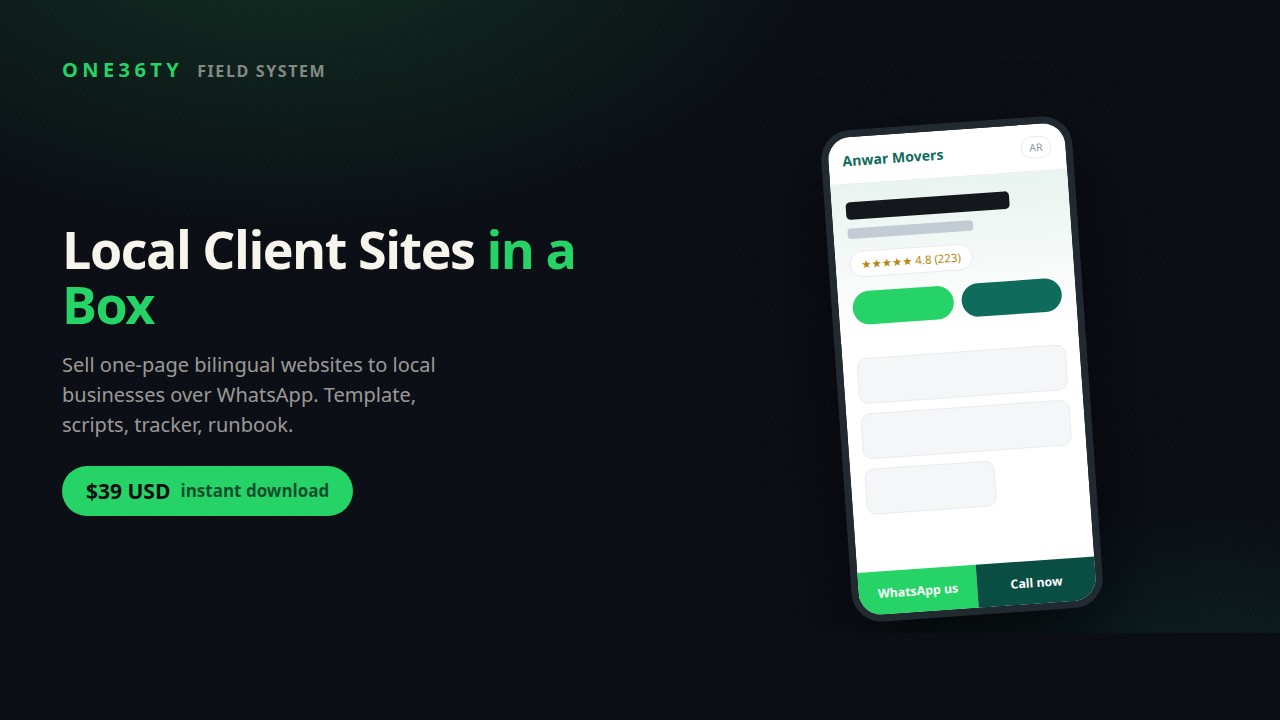
Most web outreach asks for a decision before showing anything. The system inverts that. The seller builds the site first, from a template with one editable block, deploys it to a free host, and only then sends the first message. The opener is short: I noticed 223 reviews at 4.8 stars and no website link, so I built one to look at, here is the live link, it is in Arabic and English, the green button opens a chat to this number, and if it is not wanted I will take it down.
The link is the pitch. Everything else in the manual exists to protect that one rule.
The owner can open it on the same phone while still reading the message. Their name, rating, review count and three real reviews are on it. Nothing on the demo is invented, because a fabricated review is spotted instantly by the one person who knows every customer.
The build itself is about ten minutes. Copy the template folder, edit the one BIZ block at the top of the file, deploy with a one-line command, and check it on a phone: language toggle flips the page, WhatsApp button opens the right number, call button dials, map loads. A broken link is a broken pitch.
Which businesses qualify, and why is the filter so strict?
The qualifying checklist is short and every box has to be ticked before a business goes in the tracker:
- Rating of 4.3 or higher. The reviews are the site's best content, and weak ones make a weak demo.
- Forty or more reviews. Enough proof that the business is busy and real.
- No website link on the listing, or one that is visibly broken on mobile.
- A visible mobile number that can take WhatsApp.
- A service business, not retail: movers, cleaning, AC and appliance repair, pest control, car detailing, catering, tutoring, salons, plumbers, electricians. They sell a job, not a shelf, so one new customer covers the cost of the site.
- At least one review in the last three months, photos on the listing, and not a franchise.
Government, medical and regulated services are disqualified outright. The strictness is not snobbery. Every demo costs ten minutes and a small piece of the seller's credibility, and a listing with eleven mixed reviews cannot produce a page an owner is proud enough to pay for.
Prospects are logged sixteen at a time. Five demos get built and sent, then the seller reads the replies before building the next five, because the opener changes after the first five answers. The manual expects one to three closes from a batch at best, and says plainly that the loop works by repetition, not by any single week.
The number itself has rules too. A brand-new WhatsApp number whose first activity is cold outreach is the classic pattern that gets restricted, so the system uses a separate business number, warmed up with ordinary conversations, sending five to ten personalised messages a day in week one, never a broadcast list, and stopping the moment anyone asks.
What happens between the yes and the handover?
Two follow-ups, then silence. Day plus two is a light nudge asking whether the link opened properly. Day plus five is the take-away: the demo comes down this week unless the owner wants to keep it, and here is the one-time fee and the monthly. That second message works precisely because it is true. The demo really does come down.
When the reply is yes, the intake list goes out in the same hour, not that evening. Six items: the domain name wanted, a logo if one exists, up to six real photos, the service list with prices if they want them shown, working hours, and the WhatsApp number that should receive customer messages. The gap between a yes and the intake list is the most dangerous hour in the process.
From there the runbook is hour by hour. Confirm the scope in one WhatsApp message that names what is included, the build fee, the monthly, and payment after go-live. At this size that message is the contract. Register the domain in the business's own name, with the owner as registrant. Apply the real content in both languages, connect the domain, confirm the padlock, test again on mobile data. Send the live link and the invoice together. Then ask the owner to add the site as the website link on their maps listing, from their own account. It takes two minutes and it is the most valuable thing the seller does for them, because that link sits exactly where the customers already are.
Why is the monthly care fee the actual business?
The build fee pays for the seller's afternoon. The care fee is what compounds. The manual's worked table is deliberately plain: ten care-plan clients is a monthly income that survives any single client leaving, and twenty-five is a part-time salary. Neither number is a promise. It is arithmetic on a fee the seller sets.
What keeps the care fee from quietly eating the seller's evenings is a boundary drawn in the first conversation and never moved. Included: hosting, SSL, backups, domain renewal from year two, and content edits turned around the same or next working day. Not included, and quoted separately: new pages, booking systems, payments, ad campaigns, SEO retainers, logo work. The reply script for "can you add a feature?" says yes, and then gets the base site live first so the owner is already receiving value before anything is added. The script for "it's expensive" says one extra job pays for the whole thing, then releases the pressure by leaving the demo up for two weeks. There is no discount, because releasing the pressure closes more of these than a lower price does.
The whole system fits in an evening window: overnight replies in the morning, fifteen minutes of sends in the evening, five new demos a week, care-plan invoices on the same date each month. It is a small business by design. What makes it work is not the template or the scripts but the order of events, deliver first and pitch second, and the discipline to take a demo down when the owner says no.