UK statutory redundancy pay: how the age bands and the 20-year cap decide the number
Two people on the same weekly pay with the same ten years of service can get different statutory redundancy sums. The half, one and one-and-a-half week age bands, the 20-year service cap and the £751 weekly cap from April 2026, worked on one salary.
Watch this as a video
UAE Gratuity Calculator in Excel — 21 and 30 days per year, two-year cap · Masrofna · opens on YouTube
Two people, both on £600 a week, both made redundant on the same day after exactly ten years with the same employer. One is 35, the other is 55. The 35-year-old's statutory redundancy pay is £6,000. The 55-year-old's is £9,000. Nothing about their jobs or their pay differs. The whole gap is age, and it is written into the formula.
This is the tab of the gratuity workbook that surprised me most when I built it, because it is the only one of the eight countries where the person's age changes the answer. The UAE formula does not care how old the employee is. The UK one does, year by year.
How does the age band change the number each year?
The rule sits in section 162 of the Employment Rights Act 1996, and GOV.UK's plain summary of it reads:
- "half a week's pay for each full year you were under 22"
- "one week's pay for each full year you were 22 or older, but under 41"
- "one and half week's pay for each full year you were 41 or older"
The important word is each. The band is not set once by the age on the day of redundancy and then applied to the whole service. Every year of employment carries its own rate, according to how old the employee was during that year. The Act describes the method as "reckoning backwards from the end of that period the number of years of employment" and "allowing the appropriate amount for each of those years."
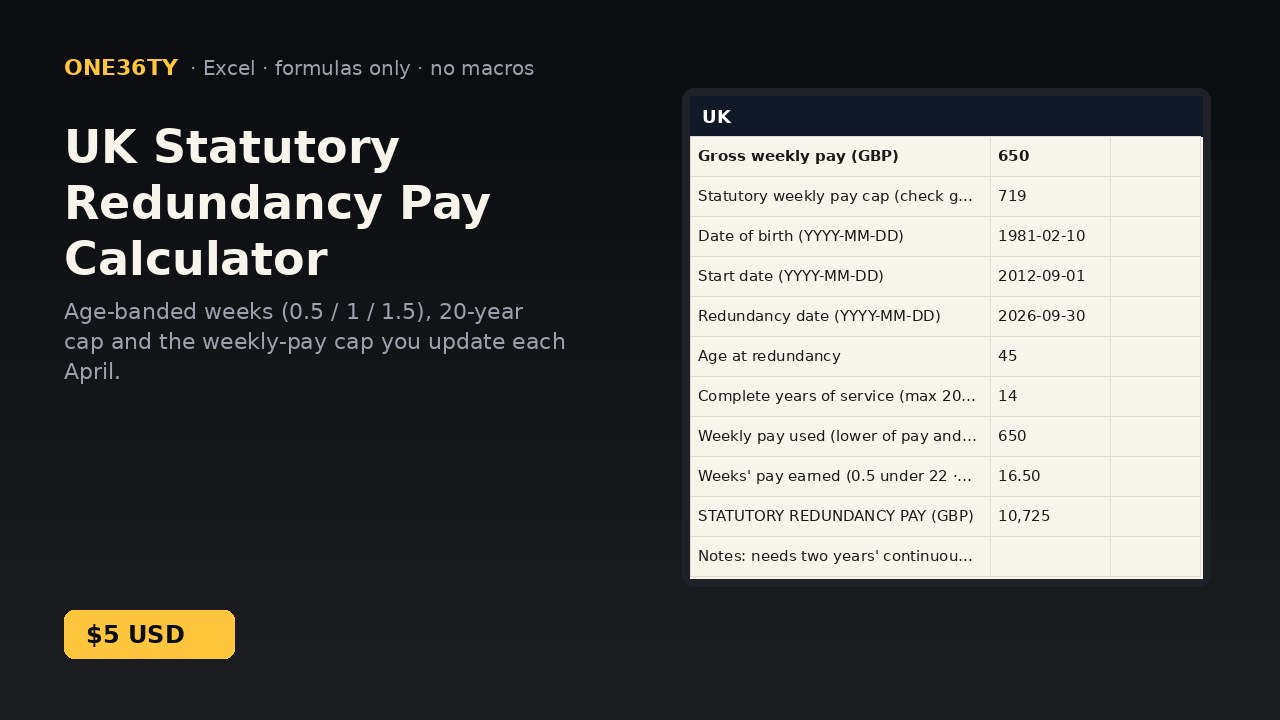
So the 55-year-old in the opening example spent all ten years aged 45 to 55, every one of them in the 41-and-over band. Ten years at one and a half weeks is fifteen weeks' pay: 15 × £600 = £9,000. The 35-year-old spent those ten years aged 25 to 35, all in the middle band. Ten years at one week is ten weeks' pay: £6,000.
Add a third person, 28 years old, who joined at 18. Six of those years were at 22 or over, four were under 22. That is six weeks plus two weeks, eight weeks' pay, £4,800. Three people, one wage, one length of service, three different sums.
The fiddly part is the year in which a birthday crosses a band, because a single year of employment can start at 40 and end at 41. The workbook works out the age in each reckoned year and applies that year's rate, which is what the official GOV.UK calculator does too, and for a boundary year the official calculator is the one to trust.
The band is not a label a person carries; it is a rate attached to each year they worked.
Only full years count. GOV.UK says "each full year", so nine years and eleven months is nine years for this purpose. And the door only opens at two years: GOV.UK puts the normal entitlement at "2 years or more" of working for the current employer as an employee.
Why do the 20-year cap and the weekly cap set a ceiling of £22,530?
Two caps sit on top of the age bands, and together they produce the headline maximum.
The first is on service. GOV.UK: "Length of service is capped at 20 years." The Act puts it more precisely: "Where twenty years of employment have been reckoned under subsection (1), no account shall be taken under that subsection of any year of employment earlier than those twenty years." Because the reckoning runs backwards from the redundancy date, it is the most recent twenty years that count. For most people those are the twenty years in which they were oldest, and so the years that carry the highest rate. The years that fall off the front are the early, cheap ones.
The second is on weekly pay. "If you were made redundant on or after 6 April 2026, your weekly pay is capped at £751 and the maximum statutory redundancy pay you can get is £22,530." That maximum is not a separate rule. It is the arithmetic of the other three: 20 years, all at one and a half weeks, at the capped wage. 20 × 1.5 × £751 = £22,530.
Here is the ceiling reached on one example. A 62-year-old earning £900 a week, made redundant in June 2026 after 25 years. Only the last 20 years count, ages 42 to 62, all in the top band, so 30 weeks. Weekly pay is £900 but the cap brings it to £751. 30 × £751 = £22,530. The five earliest years and the £149 a week above the cap contribute nothing. Someone on £751 a week with the same age and service gets exactly the same sum.
What counts as a week's pay is also defined, and it is not simply the last payslip. GOV.UK sets it as the average earned per week over "the 12 weeks before the day you got your redundancy notice". For salaried staff on a fixed wage that is the same thing. For anyone with variable hours or overtime in those twelve weeks, it is not.
The weekly cap moves each April, which is why the workbook keeps it in a single cell rather than buried in a formula. The 2026 figure is £751. Whoever opens the file in a later year changes one number and the whole sheet follows.
What is the quickest way to sanity-check a redundancy figure?
Three checks, in the order I use them.
- Count the full years, and stop at twenty. Anything past twenty is gone, from the front.
- Sort those years into the three bands by the age in each year, and total the weeks: 0.5, 1 or 1.5 per year. The total can never exceed 30.
- Multiply by the lower of the actual average weekly pay and the cap for the redundancy date. For 6 April 2026 onward that cap is £751.
If the result is above £22,530, one of the three steps has slipped. If two people with the same pay and service get different answers, the age bands are doing their job, not failing at it.
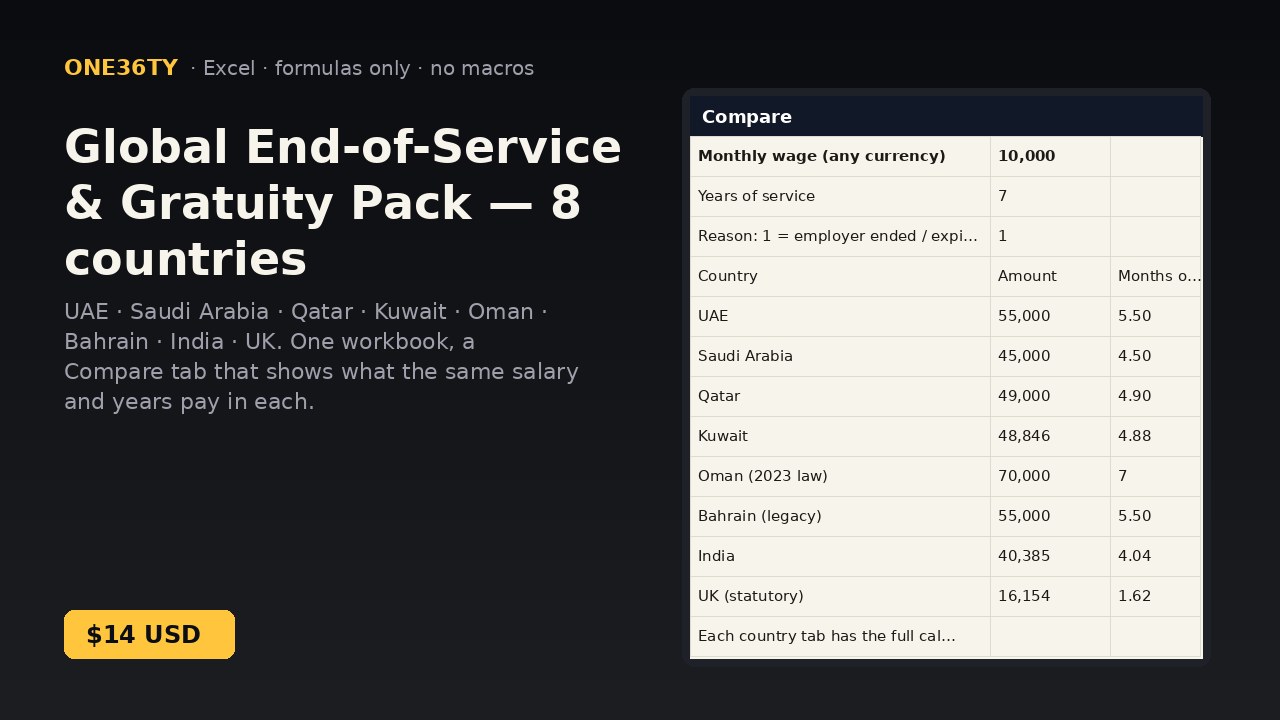
What stays with me from building this tab is how differently the UK thinks about the question from the Gulf. Every Gulf formula in the workbook treats a year of service as worth a fixed slice of wage, whoever served it. The UK formula prices a year by how old the person was when they gave it, on the view that the older worker has more to lose. Whether that is fair is a debate for someone else. The mechanics are only this: three rates, twenty years, one cap, reckoned backwards.
Sources
- Redundancy: your rights - Redundancy pay · GOV.UK
- Employment Rights Act 1996, section 162 - Amount of a redundancy payment · legislation.gov.uk