End of service calculation in Saudi Arabia: from two dates and a last wage to the final figure
The end of service calculation in Saudi Arabia in five steps: which wage counts, how the service period is counted (Hijri by default), the five-year split, what the reason for leaving does, and the payment deadline. Worked on SAR 9,500 from 1 March 2019 to 13 November 2026.
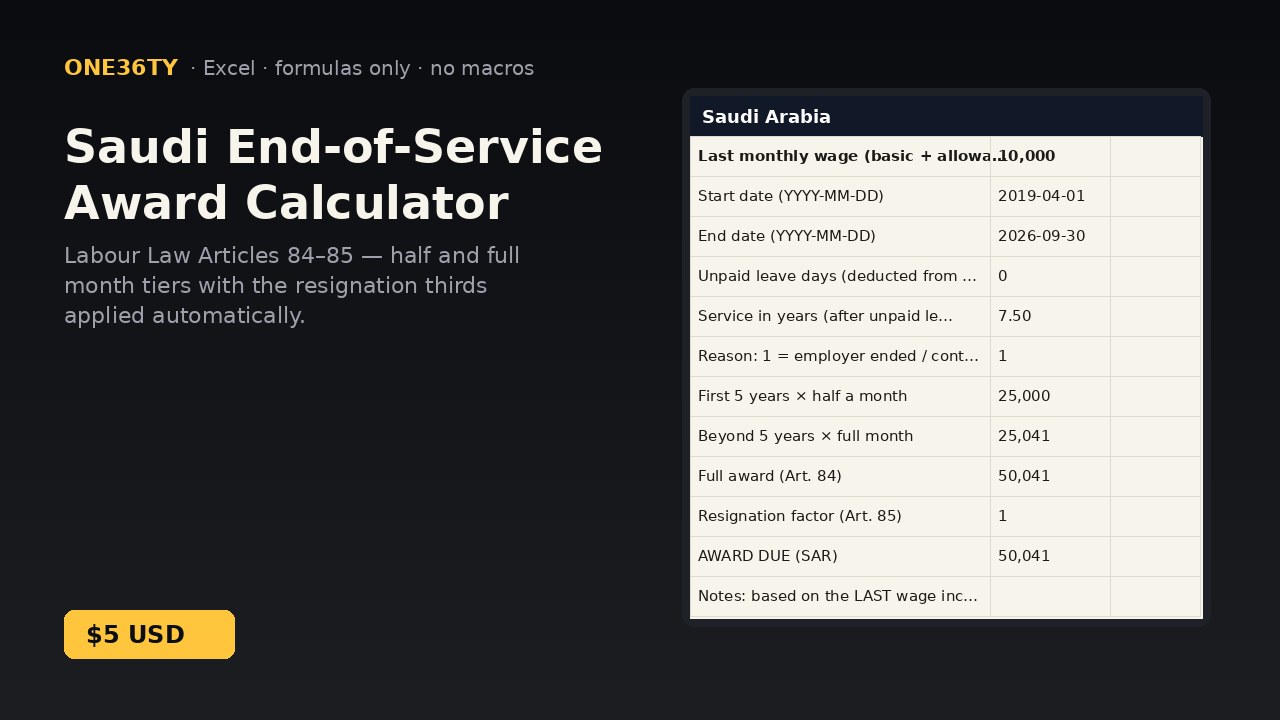
A start date of 1 March 2019, an end date of 13 November 2026, a last monthly wage of SAR 9,500, and a fixed-term contract that the employer chose not to renew. The end of service calculation in Saudi Arabia takes those four facts and returns SAR 49,396: half a month's wage for each of the first five years, a full month's wage for every year after that, with the broken year paid in proportion. The formula is Article 84 of the Saudi Labour Law. The calculation is five decisions in a row, and a colleague at the trading company where I work asked me to set them out on paper before trusting the studio's Saudi sheet.
How is end of service calculated in Saudi Arabia?
Article 84 is short. The employer "shall pay the worker an end-of-service award equivalent to the amount of a half-month wage for each of the first five years and a one-month wage for each of the following years." The award "shall be calculated on the basis of the last wage", and the worker is entitled to it "for the portions of the year in proportion to the time spent on the job."
Step one: the wage. Article 2 of the law defines "Wage" as "actual wage", which is "the basic wage plus all other due increments decided for a worker for the effort he exerts at work or for risks he encounters in the course of performing his work". Article 86 lets a contract agree that the base "does not include all or some of the commissions, sales percentages, and similar wage components" that rise and fall by nature. The example contract fixes a flat SAR 9,500 with no commission, so the question does not arise.
Step two: the period. Covered in the next section.
Step three: the split. On the example dates the Gregorian service period is 7 years, 8 months and 12 days.
| block | period | rate on SAR 9,500 | award |
|---|---|---|---|
| first five years | 5 years | 4,750 per year | 23,750 |
| after year five | 2 years, 8 months, 12 days (2.6995 years) | 9,500 per year | 25,646 |
| full award | 7 years, 8 months, 12 days | 49,396 |
Eight months is eight twelfths of a year and twelve days is twelve 365ths, and the law asks for proportion, not rounding. A sheet that rounds the broken year down to two years pays 6,646 less than Article 84 says.
How do you count the service period, and in which calendar?
Two rules shape the period. The first is Article 10: "All periods and schedules provided for in this Law shall be according to the Hijri calendar, unless otherwise stated in the employment contract or the work organization regulation." The default calendar is therefore Hijri, and a Hijri year is about eleven days shorter than a Gregorian one. Converted with the Umm al-Qura calendar, 1 March 2019 is 24 Jumada al-Thani 1440 and 13 November 2026 is 3 Jumada al-Thani 1448, so the same employment lasted 7 Hijri years, 11 months and 9 days. Counted that way, the second block is about 2.94 years instead of 2.70, and the award is roughly SAR 51,700 rather than 49,396. Most expatriate contracts state Gregorian dates, but the calendar is a clause to check.
The law fixes the formula. The two dates, the calendar they are read in, and the reason the contract ended decide how much of it reaches the final payslip.
The second rule is continuity. The ministry's awareness guide says "the calculated period also includes all consecutive years of employment, and parts of a year are calculated in proportion to its duration", so a contract renewed with the same employer keeps counting from the original start date. A fixed-term contract that both sides carry on after expiry renews, in the guide's words, "for a similar period", and the renewal does not restart the clock.
What does the reason for leaving do to the end of service calculation?
Step four: Article 84 computes the full award; the articles around it decide what share is paid.
- Employer ends it, or a fixed-term contract expires. The full award. The example falls here and pays SAR 49,396.
- Worker resigns. Article 85 scales it: "one third of the award after service of not less than two consecutive years and not more than five years, to two thirds if his service is in excess of five consecutive years but less than 10 years, and to the full award if his service amounts to 10 years or more." The ministry's page adds that a resignation under two years earns nothing. Had the example worker resigned, two thirds of 49,396 is SAR 32,930.
- Dismissal under Article 80. That article lets an employer end the contract "without giving the worker an award, advance notice, or indemnity" in nine listed cases, among them assault, forgery to obtain the job and disclosure of trade secrets. Case six is "during the probation period", and the guide confirms that no award is due for a contract ended in probation.
- Worker leaves under Article 81. Seven cases, including an employer who "fails to fulfill his essential contractual or statutory obligations towards the worker", let a worker leave without notice "without prejudice to all of his statutory rights", the award among them.
- Article 87 exceptions. A worker who leaves "due to a force majeure beyond his control" keeps the full award, as does a female worker who ends her contract "within six months from the date of her marriage or three months from the date of giving birth."
Step five is timing. Article 88 gives the employer "a maximum period of one week from the date of the end of the contractual relation" to settle, or "a period not exceeding two weeks" if the worker ended the contract, and lets the employer "deduct any work-related debt due to him from the worker's entitlements." The guide also points to the ministry's own electronic calculator for checking the result.
Is the end of service calculation the same in the UAE, Qatar and Kuwait?
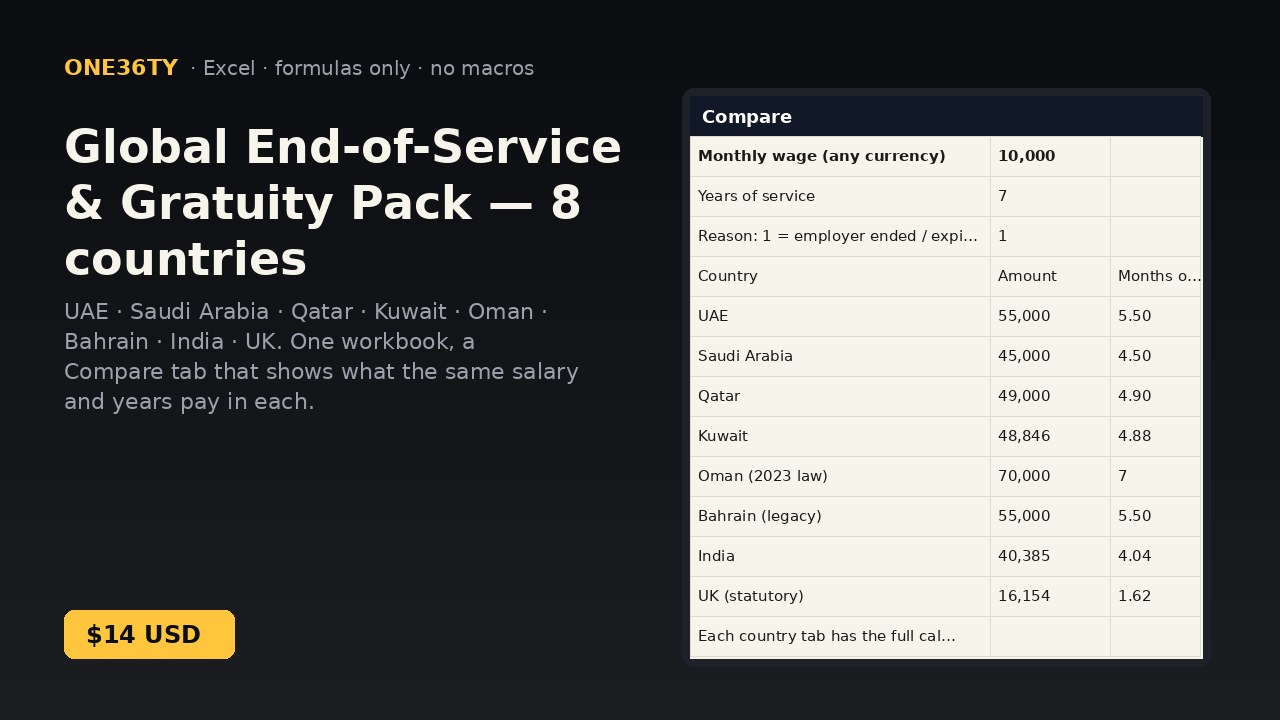
The UAE government's page sets the UAE gratuity on "the basic salary" at 21 days' wage per year for the first five years and 30 days after that, capped at two years' wage. Qatar and Kuwait use their own rates and caps, and the full table on one salary is in the UAE end-of-service calculator post. The Saudi calculation stands apart on three points: it multiplies the actual wage rather than the basic, it has no ceiling, and it defaults to a calendar that makes the same years count for slightly more.
Put the five steps together and the Saudi end of service calculation is a sequence, not a formula. Wage, period, split, reason, deadline. Each is a line in the law.
Sources
- Labor Law, Royal Decree No. M/51 of 27 September 2005 (English translation; Articles 2, 10, 80, 81, 84, 85, 86, 87 and 88) · Ministry of Human Resources and Social Development, Saudi Arabia
- End-of-service award regulations · Ministry of Human Resources and Social Development, Saudi Arabia
- Awareness Guide on the Rights and Duties of Employers and Workers, First Edition 2025 (sections 5 and 6) · Ministry of Human Resources and Social Development, Saudi Arabia
- End of service benefits for workers in the private sector · u.ae, The Official Platform of the UAE Government