Gratuity calculator India 2026: the 15/26 formula worked on one salary, and the UAE 21/30 rule for Indian expats
Gratuity in India in 2026 is the monthly wage divided by 26, times 15, for each year of service, with a part-year counted only past six months and a ₹20 lakh cap. An Indian employee on a UAE contract is paid under UAE law instead: 21, then 30 days of basic a year.
Fifteen days' wages for every completed year of service: that is gratuity in India in 2026, with the monthly basic plus dearness allowance divided by 26, a final part-year counted only past six months, and a ₹20 lakh ceiling. An Indian employee on a UAE contract is paid under UAE law instead, at 21 days of basic for each of the first five years and 30 days for each year after. A colleague at the trading company where I work, six years and four months on a Dubai contract at AED 10,000 basic, typed "gratuity calculator India 2026" into his phone and got the Indian formula. His number comes from Article 51 of Federal Decree-Law 33 of 2021, and on his salary it is AED 48,333. This post works both, because the search is one question wearing two laws.
Which gratuity law applies to an Indian employee working in the UAE?
The one the contract is written under. Article 51 of the Decree-Law speaks of "the full-time foreign worker, who completed a year or more in continuous service"; it does not ask where the worker is from. The u.ae summary, updated 15 October 2026, adds the cap: "in all cases, the total gratuity shall not exceed the wage of 2 years".
India's rule lives in the Code on Social Security, 2020, which the Press Information Bureau release of 21 November 2025 says was "made effective from 21st November 2025, rationalising 29 existing labour laws". The Code governs establishments in India. A person hired in Dubai on a Ministry of Human Resources and Emiratisation contract and paid in dirhams is outside it, however Indian the passport. Someone kept on an Indian payroll and seconded abroad is a different case, for the contract to settle.
Nationality does not pick the gratuity formula. The contract does.
How is gratuity calculated in India in 2026?
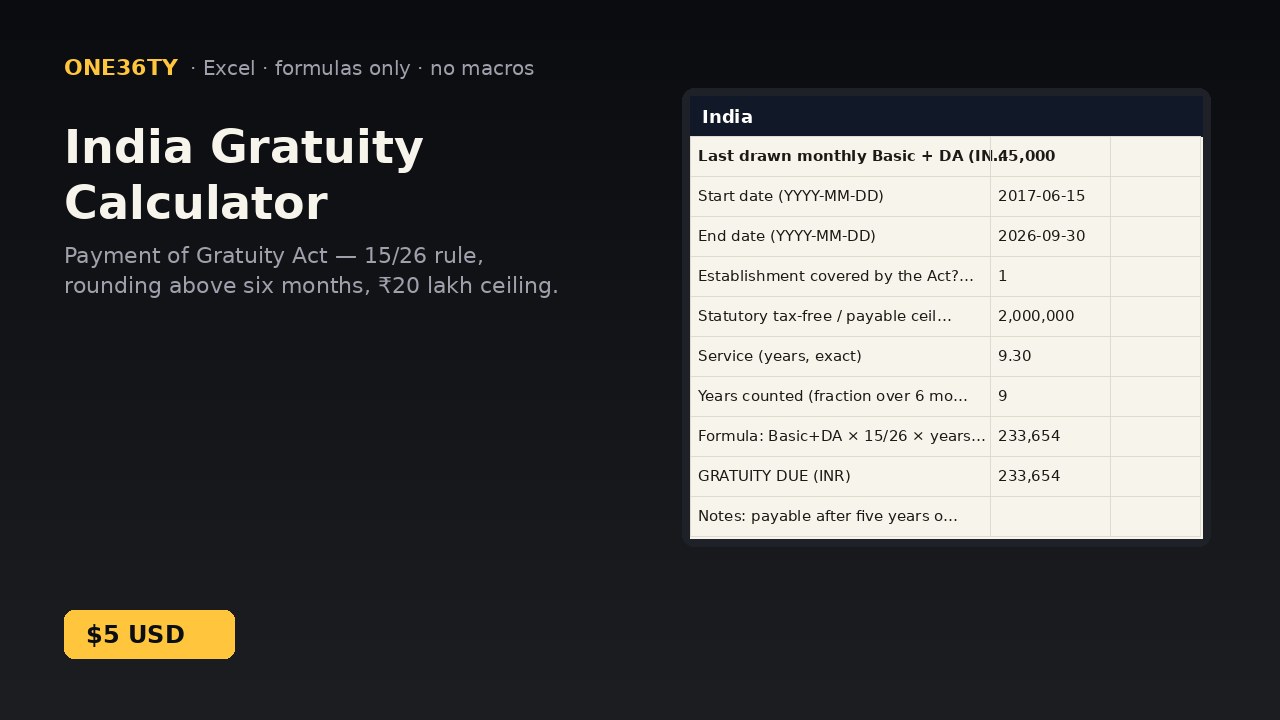
Section 53(2) of the Code keeps the old arithmetic: "For every completed year of service or part thereof in excess of six months, the employer shall pay gratuity to an employee at the rate of fifteen days' wages or such number of days as may be notified by the Central Government, based on the rate of wages last drawn by the employee concerned." Explanation 3 fixes the divisor: "in the case of a monthly rated employee, the fifteen days' wages shall be calculated by dividing the monthly rate of wages last drawn by him by twenty-six and multiplying the quotient by fifteen."
Three things follow. The daily rate is the monthly wage over 26, not 30, so fifteen days is about 57.7 per cent of a month. A final partial year counts as a whole year only if it passes six months. And wages under section 2(88) are basic pay, dearness allowance and any retaining allowance; house rent allowance, conveyance, overtime and commission stay out.
Section 53(3) caps the total at "such amount as may be notified by the Central Government"; the 30 March 2018 release records "the maximum limit to Rs. 20 Lakh".
On ₹1,00,000 a month of basic plus DA and the same six years and four months:
- Daily wage: ₹1,00,000 ÷ 26 = ₹3,846.15
- Fifteen days: ₹3,846.15 × 15 = ₹57,692.31
- Years: four months is not "in excess of six months", so six years count
- Gratuity: ₹57,692.31 × 6 = ₹3,46,154
That is 3.46 months of wage.
What changed on 21 November 2025, and does it reach a fixed-term contract?
Two things a 2025 calculator gets wrong.
First, the five-year door has a second entrance. Section 53(1) still requires "continuous service for not less than five years", but its second proviso says that completion "shall not be necessary where the termination of the employment of any employee is due to death or disablement or expiration of fixed term employment", and section 53(2) adds that for "an employee employed on fixed term employment or a deceased employee, the employer shall pay gratuity on pro rata basis". The PIB release puts it in plain words: "Fixed-term employees will become eligible for gratuity after one year of continuous service."
So a fixed-term contract of one year and eight months that ends on its own date now pays ₹57,692.31 × 20 ÷ 12 = ₹96,154 on the same wage. The PIB release states the before and after in one line: "Gratuity eligibility after just one year, instead of five."
Second, the wage base has a floor. The proviso to section 2(88) says that if the excluded items "exceeds one-half ... of the all remuneration", then "the amount which exceeds such one-half ... shall be deemed as remuneration and shall be accordingly added in wages". A package of ₹1,80,000 built as ₹70,000 basic plus DA and ₹1,10,000 of allowances has allowances over one-half of the whole by ₹20,000, so the gratuity wage is ₹90,000, not ₹70,000. How employers restructure around that is still being worked out; the arithmetic is not.
How do the UAE and India formulas compare on the same salary and service?
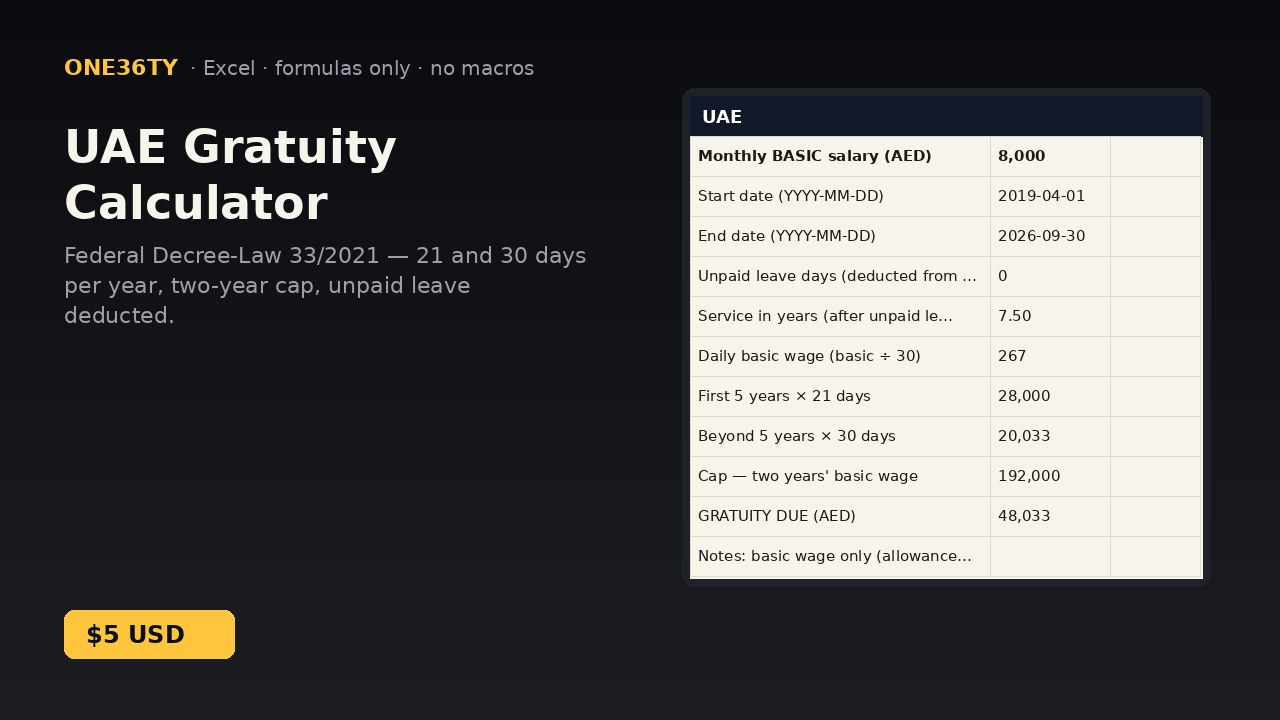
Under the law that governs the opening case, Article 51 pays "a wage of (21) twenty-one days for each year of the first five years of service" and "a wage of (30) thirty days for each year exceeding such period", counts "parts of the year in proportion to the period spent at work", and leaves out "the unpaid days of absence". A day of basic is the monthly figure over the usual 30-day month, the convention worked through in the studio's 21/30 explainer.
- Daily basic: AED 10,000 ÷ 30 = AED 333.33
- First five years: 21 × 5 = 105 days = AED 35,000
- Remaining 16 months: 30 × 16 ÷ 12 = 40 days = AED 13,333.33
- Gratuity: AED 48,333
The two laws on the same service, expressed in months of the wage each one uses:
| service | India, Code on Social Security | UAE, Article 51 |
|---|---|---|
| 1 year 8 months, fixed term | 20 ÷ 12 × 15 ÷ 26 = 0.96 months | 20 ÷ 12 × 21 ÷ 30 = 1.17 months |
| 6 years 4 months | 6 × 15 ÷ 26 = 3.46 months | 3.5 + 1.33 = 4.83 months |
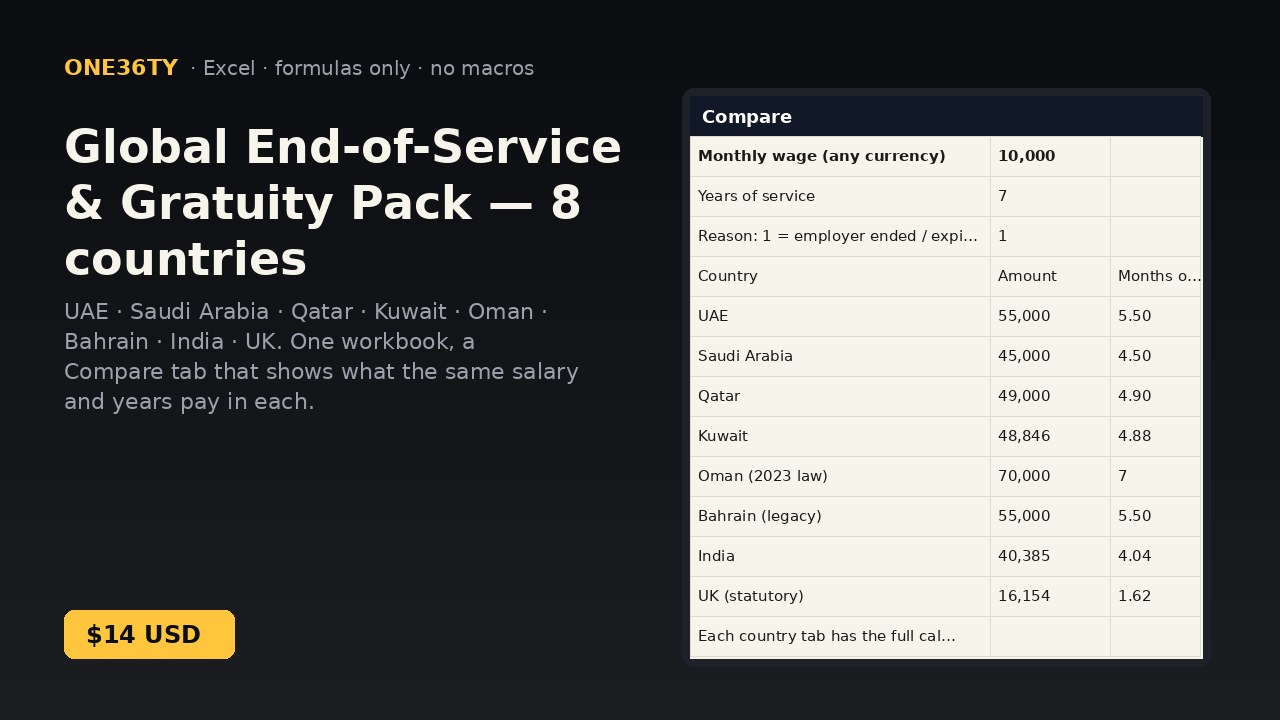
Each formula has its own trap. India rounds the last year up or discards it at the six-month line and applies a ₹20 lakh ceiling. The UAE pro-rates every month (the figure earned so far, month by month), steps the rate up after year five, and stops at 24 months of basic, a curve laid out year by year from 1 to 20. And they run on different wages: basic plus DA in India, basic alone in the UAE. The Compare tab in the studio's eight-country pack exists for exactly this: one salary, one length of service, every formula side by side.
My colleague's answer was AED 48,333, from a law his search query never mentioned. The India figure told him one thing only: what he would have been owed had he stayed home, under a different divisor, a different rounding rule and, since last November, a different door for fixed-term work.
Sources
- The Code on Social Security, 2020 (No. 36 of 2020), sections 2(88), 53 and Explanation 3 · The Gazette of India Extraordinary, Part II Section 1, 29 September 2020
- Government Makes the Four Labour Codes effective to Simplify and Streamline Labour Laws · Press Information Bureau, Ministry of Labour & Employment, 21 November 2025
- Payment of Gratuity (Amendment) Act, 2018 brought in force on 29th March, 2018 · Press Information Bureau, Ministry of Labour & Employment, 30 March 2018
- End of service benefits for workers in the private sector · u.ae, The Official Platform of the UAE Government (updated 15 Oct 2026)
- Federal Decree-Law No. (33) of 2021 Regarding the Regulation of Employment Relationships and its amendments, Article 51 · Ministry of Human Resources and Emiratisation (MOHRE)